◄ BACK
This is a work in progress - all rights reserved.
Copyright © 2006-2009 Tony Giovia
31. The Construction of a Complex Context – An Analysis - Part 2 v2.0
31.1 Dimensional representations of physical Ideas.
Part 2 – Illustrations depicting the physical nature of GA relationships.
We have been conditioned to believe that Ideas are ethereal ghosts that somehow exist without a physical form. We know Ideas exist because we can manipulate them, but we don’t consider them real like three-dimensional trees are real. The closest we come to acknowledging that Ideas have a structure is when we attribute brain neurons and synapses to having a role in thinking and memory. But we have not yet taken this concept to the next level – seeing Ideas as physical objects in their own right.
The argument for physical Ideas is a simple one: if everything in the Universe originated in a Big Bang of energy, then everything in the Universe is a product of the Big Bang and is composed of energy. Albert Einstein showed us that energy has a mass component – therefore ideas have a mass component. Mass requires matter (a physical, three dimensional entity) for its definition, therefore Ideas have a physical dimension.
We normally describe physical objects as having the dimensions of height, width and depth. Ideas, as physical objects, have at least these three dimensions – and very likely more. There are mathematical formulas – logical Ideas - that define up to eleven dimensions, and because these formulas exist, the physical structure for these logical dimensional worlds must also necessarily exist.
Beyond that, there are Ideas that refer to non-existent physical objects – for example, “Nothingness”. Physicists tell us that there is no perfect vacuum – no empty space that contains nothing – no atoms, no waves, no forces. The fact that the Idea “Nothingness” exists with no physical three-dimensional “real world” counterpart suggests that this Idea has at least the required three dimensions (remember that the Idea “Nothingness” is composed of matter) plus one or more dimensions that allow it to exist beyond a three-dimensional state. With this in mind, Ideas are “metaphysical” in the sense that they have more than three dimensions.
Perhaps an even better example of an Idea that refers to a non-existent object is an Idea upon which the entire discipline of Geometry is based. A “Point” in geometry is defined as an object with no dimensions ( ! ). And the anomalies escalate from there – a “Line” has only one dimension – length – but just try drawing a line with no width. “Planes” have length and width, but no depth. These are purely mental objects that exist as Ideas without a “real world” counterpart.
Ideas that do not appear to exist outside a mind can be better understood by visualizing them as physical objects. Below are illustrations roughly depicting the physical nature of Geometric Architectures and how the relationships between and among GAs are physically implemented. The intent is to provide a spatial, dimensional rendering of a complex context. The depiction will also help us visualize the built-in structures that facilitate secondary (i.e. “recessive”) Points of View.
Illustration 1
|
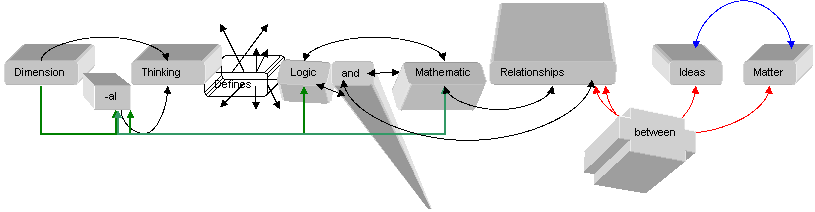
This illustration simply provides a spatial dimension to the Ideas composing the complex context. Some attention is paid to the physical pathways that define the logimathical relationships in the context.
Illustration 2
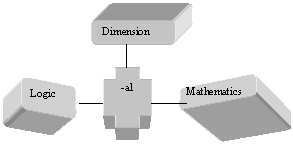
This illustrates three objects sharing a fourth object (the suffix “-al”).
Illustration 3
Shared Dimensions – “al” Shared By Mathematical, Dimensional and Logical |

This illustration attempts to provide a four dimensional rendering of a GA (“AL”) physically shared among three other GAs.
Illustration 4
|


It is useful to visualize complex contexts as a complete physical structure. The logimathical collection of a context’s composing Geometric Architectures create its “definition” – its external physical shape. This image is intended to stretch the imagination – the actual shape of a GA is still speculation.
◄ BACK